Ambiguous angelic and satanic agency
The Satanic VersesAmbiguous angelic and satanic agency is the novel’s sustained uncertainty about who—or what—causes events that appear miraculous, destructive, or transformative. Gibreel Farishta may be an instrument of divine power, a figure under demonic influence, or a human being caught in experiences that neither he nor others can reliably interpret. The narrative makes this uncertainty consequential: it affects how characters understand freedom and responsibility, and it sits beside ordinary human decisions and institutions that can also transform lives.
Doubt, will, and the angelic
The novel places doubt at the threshold between human and angelic experience. Its account of angels imagines them challenging Allah’s will and asking questions about freedom; they are then pacified by being assigned the role of instruments through which salvation and damnation operate. Their obedience appears less like a freely chosen good than an end to dissent. The passage gives a pointed definition to the disagreement: to will is to disagree, refuse submission, and dissent. It also marks this interpretation as devil talk interrupting Gibreel, so that even an apparently lucid account of angelic obedience arrives with a question hanging over its source.
That interruption matters because the novel does not provide a neutral vantage from which to classify supernatural speech. The account suggests that angels may have doubts, yet it also frames the suggestion as potentially demonic. Rather than resolve the contradiction, the narrative makes the act of interpretation part of the problem: a voice that challenges divine authority could be a truth about the costs of obedience, or the adversary’s attempt to mislead. The reader is left to weigh both possibilities without a final ruling.
The fall and the unresolved miracle
The uncertainty becomes physical in the fall of Gibreel and Saladin Chamcha from the Bostan airliner. They are the only two survivors, and they are found on a beach after falling from the wreck. A witness gives an extraordinary account in which they seem to travel over the water, while Saladin, wearing a sodden bowler hat, offers a more ordinary expression of their good fortune. These incompatible descriptions make the survival legible both as a miracle and as an event that can be recounted without supernatural explanation.
The narrator claims to have watched the whole event, but does not use that claim to close the question. Instead, the narrative places Gibreel’s action beside Saladin’s will, suggesting that Saladin willed something and Gibreel did what was willed. It then asks whether Gibreel is the miracle worker and whether his song is angelic or satanic. The paired questions refuse the comfort of treating apparent power as proof of moral or divine authority. Gibreel may be acting, obeying, or channeling an agency that cannot be distinguished from his own; Saladin’s will, meanwhile, complicates any account that makes Gibreel the sole cause.
When they awaken on the English beach, Gibreel addresses them as if they have been born again, and Saladin wakes coughing and crying. The rebirth language gives their survival a spiritual shape, but it does not settle whether the fall was an intervention, a coincidence, or an experience later made meaningful through narration. The scene’s juxtaposition of a vivid miracle claim with the survivor’s plainspoken luck keeps those explanations in suspension.
Voices that accuse and interpretations that divide
Gibreel’s later encounter with the voice of the dead Rekha Merchant extends the uncertainty from miraculous action to guilt and punishment. Rekha’s voice accuses him of having stayed away during his illness and of using that absence, together with his involvement with another woman, as a reason to leave. She curses him and associates him with hell and the devil; her speech is followed by verses in an unfamiliar language in which Gibreel thinks he may hear the name Al-Lat. He is frightened and asks the voice to go, then clutches at Saladin as they fall through the clouds.
The passage gives Rekha’s accusation force without independently confirming its supernatural source or the authority of her curse. Her words may represent a dead woman’s return, Gibreel’s burden of guilt, or a voice filtered through his unstable experience. The movement from intimate reproach to unfamiliar, religiously charged language sharpens rather than dispels the ambiguity. Because the narrative presents the accusation as an experience Gibreel undergoes, it allows the emotional consequence to be clear while leaving its metaphysical status unsettled.
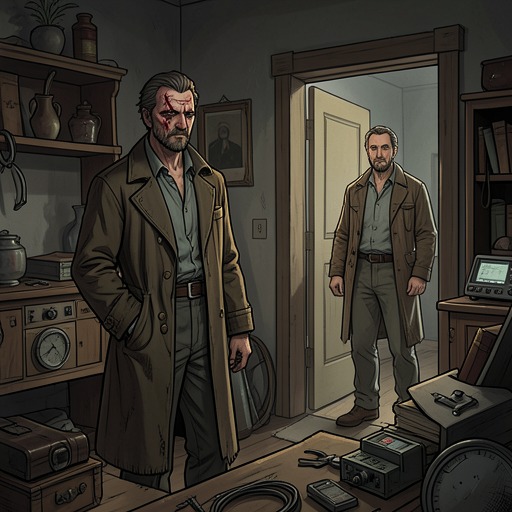
The novel also shows how easily interpretation can be imposed by people who claim no supernatural insight. After an anonymous report about a suspicious person on the beach, fifty-seven uniformed constables and thirteen dogs search the shore; five officers guard the exits at Rosa Diamond’s house while immigration officials join the search. They identify Saladin as their quarry, and the crowd of police prevents Rosa from seeing clearly or hearing his explanation that he survived the Bostan disaster. His account is treated as comic invention, and his claim to be Maxim from The Aliens Show is dismissed. The scene makes the distinction between strange events and believed events a matter of authority: the officials’ interpretation has immediate consequences regardless of what actually happened.
Names, institutions, and distributed responsibility
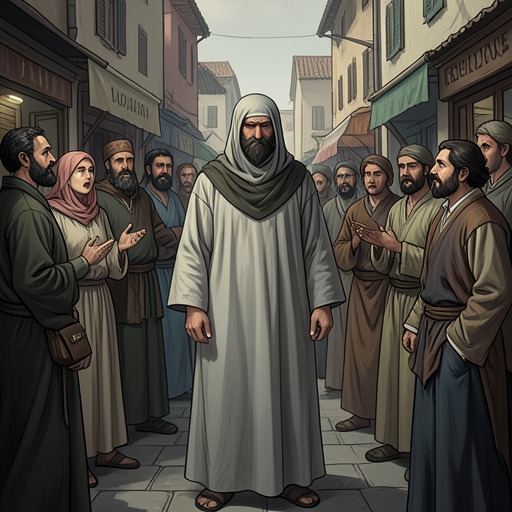
Saladin tries to establish an identity that can be verified by more than his altered appearance. He gives his full name, professional name, memberships, and car registration details, and asks that the computer be consulted. The evidence he offers is specific, but the officers continue to interpret his body and name through racialized assumptions about who can count as English. His appeal to official records exposes the gap between identity as a sustained personal history and identity as a category imposed by others. In this episode, agency does not belong only to supernatural forces: institutions shape what a person can say, what others will believe, and what happens next.
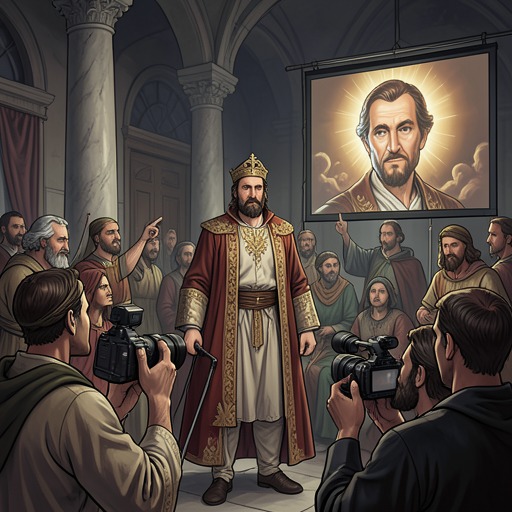
The same problem of assigned identity appears in the decision to dismiss Saladin from The Aliens Show. Its creator, Hal Valance, takes seventeen seconds to congratulate him on being alive before explaining that the show no longer wants him. Valance argues that Saladin makes the program too racial and that its audience wants entertainment not defined as an ethnic show. Saladin, disguised in an ill-fitting turban, recognizes the commercial logic behind the explanation but cannot change the decision. The scene links public representation to power: an identity can be made conspicuous when it serves a market and treated as a liability when it does not.
The account of Uhuru Simba’s death in custody offers another clash between official explanation and contested agency. Authorities attribute his death to a nightmare, while his mother, Antoinette Roberts, challenges the description of the incident as an extraordinarily unlikely accident. His solicitor, Hanif Johnson, points to the unoccupied second bunk and the absence of witnesses other than the prison officers, and argues that the nightmare is not the only possible explanation for the screams. The narrative does not establish an alternative cause, but it makes clear how institutional statements can contain uncertainty rather than eliminate it. Across the supernatural visions, the beach search, and the disputed death, the novel resists a simple division between angelic action, satanic interference, and human responsibility: authority may name the cause, but naming does not always make it knowable.